

How To Make Cottage Cheese At Home With Just 3 Ingredients

Making cottage cheese at home sounds like one of those complicated old-fashioned kitchen skills, but it is surprisingly simple.
You do not need rennet, specialist cultures or expensive cheesemaking equipment. With milk, vinegar and salt, you can turn an ordinary bottle of milk into soft, fresh cottage cheese in around 45 minutes.
The secret that gives homemade cottage cheese its familiar mild flavour is not a fancy ingredient. It is rinsing the curds after they have formed. This removes much of the sharp acidic taste and leaves you with soft, clean-tasting curds that can be eaten plain, seasoned with herbs or mixed with a little cream.
It is a brilliant beginner cheesemaking recipe, especially when milk is reduced, nearing its use-by date or simply cheaper than buying tubs of ready-made cottage cheese.
What Is Cottage Cheese?
Cottage cheese is a soft, fresh cheese made from small milk curds. Unlike Cheddar, Parmesan and other aged cheeses, it does not need to be pressed into a wheel or matured for months.
Traditional cottage cheese is often made using bacterial cultures and rennet. This quick homemade version uses an acid, such as white vinegar or lemon juice, to separate hot milk into:
- Curds: The soft white solids that become the cheese
- Whey: The pale yellow liquid left behind
The curds are drained, rinsed and lightly salted. You can leave them dry and crumbly or stir in a little milk or cream for the softer, creamier texture found in shop-bought cottage cheese.
Cottage Cheese, Ricotta And Farmer’s Cheese
These fresh cheeses are similar, but they are not exactly the same.
Cottage cheese has loose, moist curds that are rinsed to give them a mild flavour.
Farmer’s cheese is normally drained for longer, making it firmer, drier and easier to slice or crumble.
Ricotta is traditionally made by reheating whey, although many quick homemade ricotta recipes use whole milk and acid.
For a firmer fresh cheese, you can also try my Farmer’s Cheese – Easiest Homemade Cheese Recipe. The full URL is included in the internal-links section at the bottom of this article.
Homemade Cottage Cheese Recipe
Preparation time: 10 minutes
Cooking and resting time: 25 minutes
Draining time: 10 to 15 minutes
Total time: Approximately 45 minutes
Estimated yield: 300 to 400g, depending on the milk and draining time
Ingredients
- 2 litres whole pasteurised milk
- 60ml white vinegar, approximately 4 tablespoons
- ½ teaspoon fine salt, or to taste
Keep another 1 to 2 tablespoons of vinegar nearby. You may need a little more if the milk does not separate completely.
Optional Creamy Finish
For creamier cottage cheese, stir in one of the following after draining:
- 2 to 4 tablespoons single cream
- 2 to 4 tablespoons whole milk
- 1 to 2 tablespoons natural yoghurt
These are optional and are not needed to make the basic three-ingredient recipe.
Equipment You Will Need
- Large stainless-steel saucepan
- Wooden spoon or silicone spatula
- Kitchen thermometer, recommended but not essential
- Colander or fine-mesh strainer
- Cheesecloth, muslin or a clean thin tea towel
- Large bowl
- Airtight storage container
Make sure everything that will touch the cheese is thoroughly clean before you begin.
How To Make Cottage Cheese Step By Step
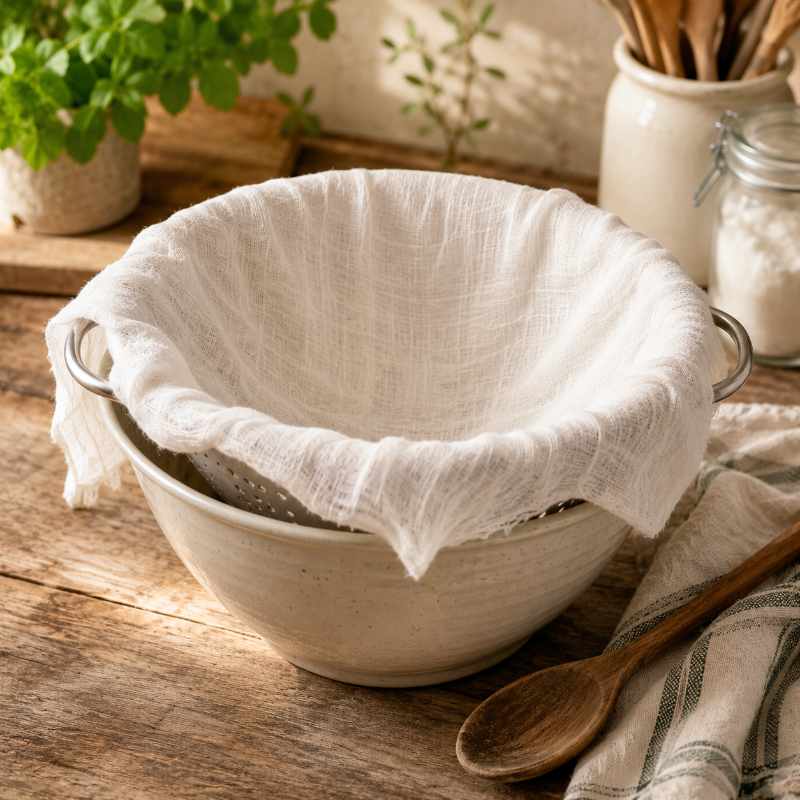
Step 1: Prepare The Strainer
Place a colander over a large bowl and line it with cheesecloth, muslin or a clean tea towel.
Leave enough material hanging over the sides so you can gather it around the curds if needed.
Preparing this before heating the milk means you will be ready to strain the cheese as soon as the curds have formed.
Step 2: Heat The Milk Slowly
Pour the milk into a large saucepan and place it over medium-low heat.
Heat the milk slowly, stirring occasionally to stop it from catching on the bottom of the pan.
Bring it to approximately 88°C to 90°C, or 190°F to 194°F. The milk should be steaming, with small bubbles appearing around the edge, but it should not be boiling vigorously.
Heating too quickly can scorch the milk and give your cottage cheese an unpleasant cooked flavour.
Step 3: Add The Vinegar
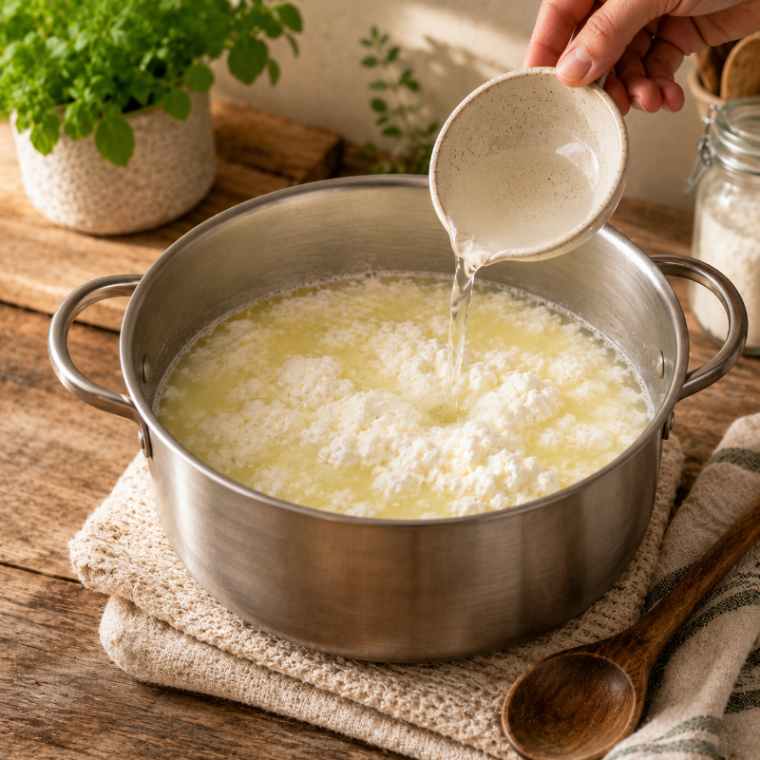
Remove the saucepan from the heat.
Slowly pour in the 60ml of white vinegar while gently stirring the milk once or twice.
Stop stirring and leave the mixture undisturbed for 10 minutes.
You should see white curds separating from a pale yellow or greenish liquid. That liquid is the whey.
If the liquid still looks very white and milky after 10 minutes, add another tablespoon of vinegar. Stir very gently and wait another five minutes.
Avoid adding large amounts of vinegar at once. Too much can make the finished cheese unnecessarily sour.
Step 4: Break The Curds
For smaller cottage cheese curds, gently move a spoon through the mixture a few times.
Do not whisk or stir vigorously. Rough handling will break the curds into tiny pieces that may escape through the cloth.
For larger curds, disturb the mixture as little as possible.
Step 5: Drain The Curds
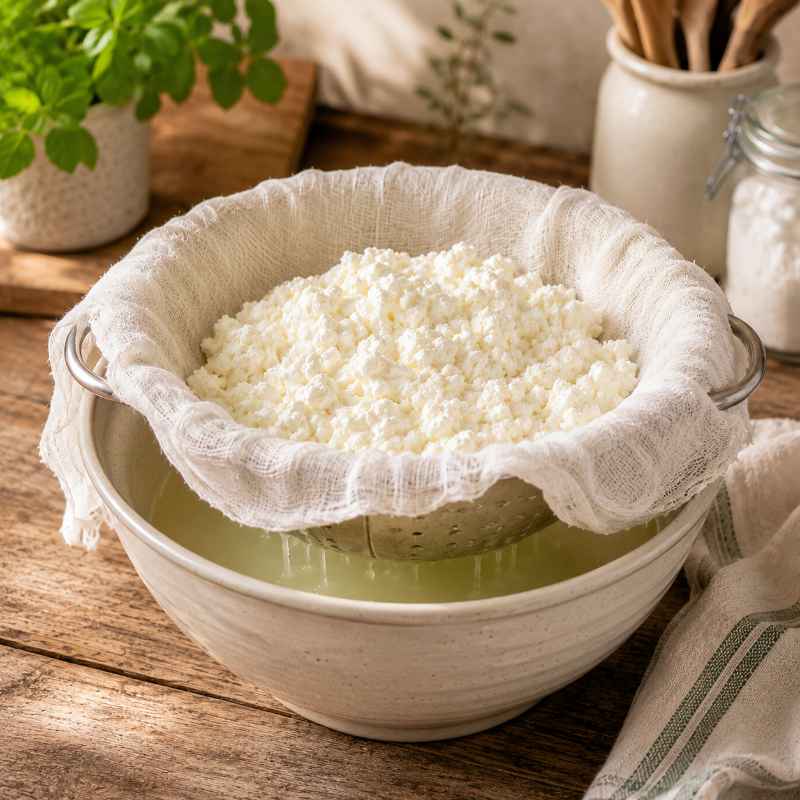
Carefully pour the curds and whey into the prepared colander.
Allow most of the whey to drain into the bowl. This normally takes five to ten minutes.
Do not press the curds firmly unless you want a drier cheese. Cottage cheese should retain some moisture.
Save the whey rather than pouring it away. There are several useful ways to use it later in this article.
Step 6: Rinse With Cold Water
This is the step that turns sharp acid-set curds into mild cottage cheese.
Run clean, cold water gently over the curds while carefully lifting and moving them with clean fingers or a spoon.
Continue rinsing for one to two minutes, or until the curds are completely cool.
Rinsing removes some of the remaining vinegar and whey. It also stops the curds from continuing to cook.
Allow the cottage cheese to drain for another five minutes.
Step 7: Add The Salt
Transfer the drained curds to a clean bowl.
Sprinkle over ½ teaspoon of salt and mix gently. Taste the cheese and add a little more if required.
The cottage cheese can now be eaten as it is, or you can make it creamier.
Step 8: Make It Creamy
For a traditional creamy finish, stir in one tablespoon of milk or cream at a time.
Stop when the cottage cheese reaches the consistency you prefer. Some people like loose, creamy cottage cheese, while others prefer drier and more distinct curds.
Remember that the curds may release a little more moisture while resting in the refrigerator.
Homemade Cottage Cheese With Just 3 Ingredients
Soft, fresh cottage cheese made from ordinary milk, vinegar and salt. No rennet, starter culture or specialist equipment needed.
Ingredients
- 2 litres whole pasteurised milk (about 8½ US cups)
- 60ml white vinegar (4 tablespoons)
- ½ teaspoon fine salt, or to taste
Keep Nearby
- 1 to 2 extra tablespoons vinegar, only if the milk does not fully separate
Optional Creamy Finish
- 2 to 4 tablespoons single cream or whole milk
Equipment
- Large stainless-steel saucepan
- Wooden spoon or silicone spatula
- Kitchen thermometer
- Colander or fine-mesh strainer
- Cheesecloth, muslin or clean thin tea towel
- Large bowl and airtight container
Method
-
Prepare the strainer
Set a colander over a large bowl and line it with cheesecloth, muslin or a clean thin tea towel.
-
Heat the milk
Pour the milk into a large saucepan. Heat slowly over medium-low heat, stirring occasionally, until it reaches 88°C to 90°C, or 190°F to 194°F. It should be steaming with small bubbles around the edge, but not vigorously boiling.
-
Add the vinegar
Remove the pan from the heat. Slowly pour in the vinegar and stir gently once or twice. Stop stirring and leave the mixture undisturbed for 10 minutes.
-
Check the curds
The milk should separate into white curds and pale yellow whey. If the liquid is still very milky, add 1 extra tablespoon of vinegar, stir gently and wait another 5 minutes.
-
Drain
Carefully pour the curds and whey into the lined colander. Allow the curds to drain for 5 to 10 minutes. Do not squeeze them unless you prefer a drier cheese.
-
Rinse the curds
Run clean cold water gently over the curds for 1 to 2 minutes, moving them carefully with clean fingers or a spoon. This removes excess acidity and gives the cottage cheese its mild flavour.
-
Season
Leave the curds to drain for another 5 minutes, then transfer them to a clean bowl. Fold in the salt and taste before adding any more.
-
Make it creamy
For softer cottage cheese, stir in milk or cream 1 tablespoon at a time until it reaches your preferred consistency. Cover and refrigerate promptly.
Important Food-Safety Note
Use pasteurised milk and keep your utensils, cloths, work surfaces and storage container thoroughly clean. Raw or unpasteurised milk may contain harmful bacteria, and pasteurisation reduces that risk. Fresh dairy products should be refrigerated promptly, with the fridge kept between 0°C and 5°C. (U.S. Food and Drug Administration)
The NHS lists cottage cheese made with pasteurised milk among the soft cheeses that can be eaten during pregnancy. However, homemade fresh cheese requires particularly careful hygiene because it has no sealed commercial packaging or printed use-by date. (nhs.uk)
Anyone who is pregnant, elderly, immunocompromised or preparing food for a very young child should take extra care and seek professional advice when uncertain.
How Long Does Homemade Cottage Cheese Last?
Transfer the cottage cheese to a clean airtight container as soon as it has drained and cooled.
Store it in the coldest suitable part of the refrigerator, rather than in the door.
As a cautious home-kitchen guideline, use homemade cottage cheese within three to four days. Always use a clean spoon when serving it.
Discard the cheese if you notice:
- An unpleasant or unusual smell
- Slimy curds
- Pink, blue, green or black discolouration
- Visible mould
- A swollen storage container
- Unexpected fizzing or bubbling
Do not taste food to decide whether it is safe if it already looks or smells spoiled.
Can You Freeze Homemade Cottage Cheese?
You can freeze cottage cheese, but the texture will change.
Freezing causes the curds to become more crumbly and may make the liquid separate when the cheese thaws. It is unlikely to have the same creamy texture for eating on toast or with fruit.
Frozen cottage cheese is better used in:
- Lasagne
- Pasta bakes
- Pancakes
- Muffins
- Bread dough
- Scrambled eggs
- Cooked sauces
Freeze it in small airtight portions and thaw it in the refrigerator before using. Stir it well after thawing.
For another cheese-storage project, my guide to dehydrating cheese for long-term storage explains a different method suited to firmer cheeses.
Easy Cottage Cheese Flavour Variations
Once you have made the basic cheese, you can change it in dozens of ways.
Garlic And Herb
Mix in:
- Chopped chives
- Finely chopped parsley
- A small amount of crushed garlic
- Black pepper
Leave it in the refrigerator for 30 minutes before serving so the flavours can develop.
Sweet Cinnamon
Add:
- A small drizzle of honey
- A pinch of cinnamon
- Chopped apple or pear
This makes a simple breakfast or afternoon snack.
Spicy Cottage Cheese
Stir in:
- Chilli flakes
- Smoked paprika
- Chopped spring onion
- A squeeze of lime
Serve it in wraps, on baked potatoes or alongside roasted vegetables.
Whipped Cottage Cheese
Place the finished cottage cheese in a blender or food processor.
Blend until smooth, adding a spoonful of milk if needed. The result can be used as a spread, dip or lighter alternative to some cream cheese-based fillings.
Ways To Use Homemade Cottage Cheese
Homemade cottage cheese is much more versatile than it first appears.
Try it:
- Spread over toast with sliced tomato
- Spoon over a baked potato
- Mixed into scrambled eggs
- Added to pancake batter
- Layered into lasagne
- Blended into a creamy pasta sauce
- Served with berries and honey
- Added to savoury muffins
- Mixed into salads
- Used in cheesecake-style desserts
- Served with crackers and homemade jam
It would also fit nicely into several of the ideas in my Quick Breakfast Recipes That Boost Energy article.
What Can You Do With The Leftover Whey?
The pale liquid left after straining is known as acid whey.
It contains water, milk sugar, minerals and small amounts of protein. Its tangy flavour makes it particularly useful in baking.
You can use it:
- Instead of water in bread dough
- In pancakes, waffles or muffins
- In scones and biscuits
- As part of the liquid in soups
- For cooking rice or grains
- In savoury sauces
- In small amounts in smoothies
- As an acidic addition to marinades
Keep whey in a clean sealed container in the refrigerator and use it promptly.
Do not use whey as a shelf-stable preserving liquid. It is a fresh dairy by-product and must remain refrigerated.
Tips For Better Homemade Cottage Cheese
Use Whole Milk
Whole milk generally gives the cottage cheese a softer texture and better yield.
Semi-skimmed milk can work, but the curds are likely to be leaner and slightly drier.
Avoid UHT Milk When Possible
Long-life UHT milk has been exposed to higher processing temperatures. It may still separate, but the curds can be smaller, softer or less predictable.
Fresh pasteurised milk is normally the easiest option for beginners.
Heat The Milk Gradually
A thick-bottomed pan and gentle heat reduce the risk of scorching.
Stir along the bottom and around the edges of the saucepan, where milk is most likely to catch.
Add Acid Gradually
Different milks may need slightly different amounts of vinegar.
Begin with the measured quantity, wait for the curds to form and only add more if the whey remains milky.
Do Not Skip Rinsing
Without rinsing, this quick cheese will taste more like sharp farmer’s cheese.
Cold-water rinsing gives cottage cheese its milder flavour and helps create separate curds.
Do Not Over-Drain It
Cottage cheese should be moist.
If you leave it hanging in cheesecloth for an hour, you will move closer to making a dry farmer’s cheese.
Common Cottage Cheese Mistakes
The Milk Did Not Separate
The milk may not have been hot enough, or there may not have been enough acid.
Return it to gentle heat if necessary, then add another tablespoon of vinegar and wait five minutes.
The Curds Are Rubbery
The milk may have boiled, or the curds may have been heated and stirred for too long.
Use slower heat and handle the curds more gently next time. Excessive heat causes curds to contract and release too much moisture.
The Cheese Tastes Too Sour
The curds may need more rinsing, or too much vinegar may have been added.
Rinse them thoroughly under cold water and add acid gradually in future batches.
The Cottage Cheese Is Too Dry
The curds may have drained for too long.
Stir in a small amount of milk, cream or natural yoghurt to restore moisture.
The Yield Is Very Small
Low-fat milk, very heavily processed milk or insufficient curdling can all reduce the yield.
Use fresh whole pasteurised milk and make sure the whey becomes pale and reasonably clear before straining.
Frequently Asked Questions
Can I Make Cottage Cheese With Semi-Skimmed Milk?
Yes. Semi-skimmed milk should still form curds, but the finished cheese may be less creamy and the total yield may be lower.
Whole milk gives the richest and most reliable result.
Should I Use Vinegar Or Lemon Juice?
White vinegar provides predictable acidity and has a neutral flavour once the curds have been rinsed.
Lemon juice can also work, but its acidity varies between fruits. You may need to add slightly more, and a mild citrus flavour may remain.
Can I Use Apple Cider Vinegar?
You can, but it may give the cheese a light apple or vinegar flavour.
Plain white vinegar is normally the best option when you want neutral-tasting cottage cheese.
Can I Make Cottage Cheese With Goat’s Milk?
Yes, pasteurised goat’s milk can be used.
Goat’s milk often forms softer, more delicate curds than cow’s milk, so handle them gently and allow extra time for draining.
Why Does Cottage Cheese Need To Be Rinsed?
Rinsing removes much of the remaining acid and cools the curds quickly.
This creates the mild flavour and loose, separate texture associated with cottage cheese.
Is Homemade Cottage Cheese High In Protein?
Cottage cheese contains milk protein because the curds are largely formed from casein.
The exact protein content of a homemade batch will vary according to the milk used, yield, moisture level and amount of cream added. A laboratory-tested nutrition calculation would be needed for an exact figure.
Can I Make It Without Salt?
Yes. The salt is primarily for flavour in this quick recipe.
You can leave it out or add only a small pinch. Unsalted cottage cheese works particularly well in baking and sweet recipes.
Is This The Same As Traditional Cultured Cottage Cheese?
Not exactly.
Traditional cottage cheese may use starter cultures and rennet to form the curds slowly. This recipe is a quick acid-set version designed for the home kitchen.
It produces a similar mild, loose-curd cheese without specialist ingredients.
Can I Double The Recipe?
Yes, provided your saucepan is large enough to hold the milk safely without overflowing.
A larger batch may take longer to heat. Add the vinegar gradually rather than assuming every batch will require exactly the same amount.
Final Thoughts
Learning how to make cottage cheese at home is an ideal introduction to cheesemaking.
The process is simple enough for beginners, but it still teaches the basic stages behind many cheeses: heating milk, forming curds, separating whey, draining and seasoning.
Start with pasteurised whole milk, heat it gently and add the vinegar gradually. Most importantly, rinse the curds well. That one small step is what changes a sharp fresh cheese into mild, soft cottage cheese.
Once you have mastered this recipe, you may want to try making homemade Colby cheese or take on a longer project with my guide to making Parmesan-style cheese at home