

Coming to Your State? – The Purple Paint Law

Make sure to like Living Green and Frugally on Facebook, Shop at Amazon to help support my site and explore our PINTEREST BOARDS for innovative ways you can become self-sufficient.
Have you ever noticed a bright purple stripe painted on a tree or fence post while walking, hunting, or driving through the countryside?
It may look like an ordinary property marker, but in many parts of the United States, that splash of purple carries an important legal message:
Private property. No trespassing. Keep out.
Known as the Purple Paint Law, this simple system allows landowners to use painted markings instead of traditional “No Trespassing” signs.
Many states now recognize some form of painted property notice. However, the approved colour, placement, size, and legal meaning can vary considerably from one state to another. Some states use purple, while others may recognize orange, blue, red, or aluminium-coloured markings.
What Does Purple Paint Mean?
In states with a Purple Paint Law, properly placed purple marks may provide the same legal notice as a printed “No Trespassing” sign.
The markings are normally painted on:
- Trees
- Fence posts
- Permanent boundary posts
- Other legally approved, immovable objects
When you see these marks while hiking, hunting, fishing, or exploring rural land, the safest response is simple:
Stop, remain outside the marked boundary, and find another route.
Purple paint is not usually a trail marker, forestry symbol, or invitation to enter. It normally means that the landowner has formally posted the property.
However, it does not mean that the landowner is allowed to threaten or harm anyone. It is a legal notice concerning access to private property, not permission to use violence.
Why Use Paint Instead of Signs?
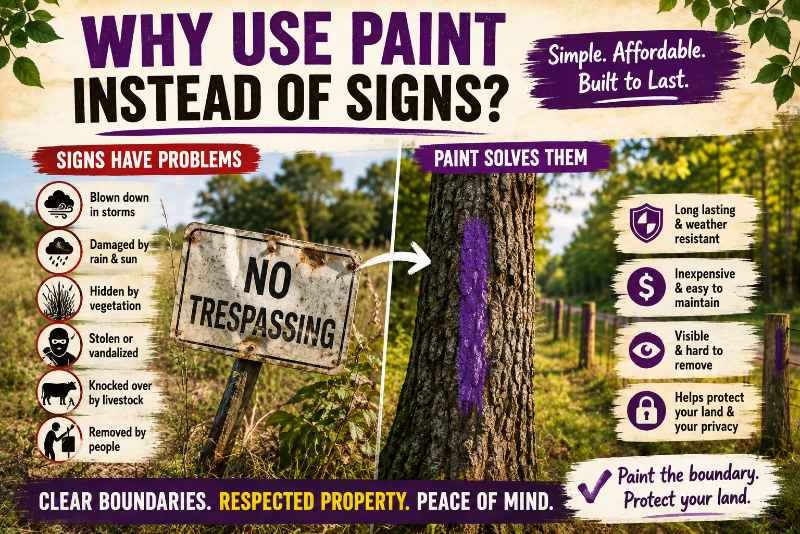
Anyone who owns rural land knows how difficult signs can be to maintain.
Signs may be:
- Blown down during storms
- Damaged by rain and sunlight
- Hidden by summer vegetation
- Stolen or vandalized
- Knocked over by livestock
- Removed by people who want to ignore them
Purple paint is inexpensive, difficult to remove, and often lasts much longer than a lightweight sign.
This makes painted boundaries especially useful for farms, woodland, hunting land, and larger homesteads where dozens of signs might otherwise be needed.
Purple Paint Laws Are Different in Every State
One of the biggest mistakes people make is assuming that the same rules apply everywhere.
They do not.
The required colour, stripe size, height, and spacing may change as soon as you cross a state line. Some laws apply to all forms of trespassing, while others focus mainly on hunting, fishing, or trapping.
Here are a few examples of how the rules may differ.
Purple Paint Laws Are Different in Every State
One of the biggest mistakes people make is assuming that the same Purple Paint Law rules apply everywhere.
They do not.
The required colour, stripe size, height, spacing, and legal meaning can change from one state to another. Some laws apply to all forms of trespassing, while others mainly cover activities such as hunting, fishing, or trapping.
Here are a few examples of how the rules may differ.
Missouri
Missouri landowners and tenants may mark private property with vertical purple lines that are at least eight inches long.
The bottom of each line must normally be positioned between three and five feet above the ground. The markings generally cannot be placed more than 100 feet apart.
Missouri may also allow the upper portion of certain fence posts to be marked with purple paint, although separate height and spacing requirements can apply.
Texas
Texas requires vertical purple lines that are at least eight inches long and one inch wide.
The bottom of each mark must be positioned between three and five feet above the ground.
The maximum distance between the markings depends on the type of land. Every mark must also be clearly visible to someone approaching the property.
Illinois
Illinois recognizes vertical purple lines that are at least eight inches long.
The markings must normally be positioned between three and five feet above the ground and placed no more than 100 feet apart.
The state may also allow the top portion of certain posts to be painted purple, although different height and spacing requirements may apply.
Pennsylvania
Pennsylvania allows purple lines that are at least eight inches long and one inch wide.
The bottom of each mark must be positioned between three and five feet above the ground. The markings must generally be placed no more than 100 feet apart.
Some counties may be excluded from the Purple Paint Law, so landowners should check the current rules for their specific location.
North Carolina
North Carolina allows purple marks that are at least eight inches long, with the bottom positioned between three and five feet above the base of the tree or post.
The markings must be clearly visible and placed within the maximum distance permitted by state law.
North Carolina’s law is particularly connected with written permission for activities such as hunting, fishing, and trapping on posted land. This is a good example of why you should never assume that every Purple Paint Law has exactly the same meaning.
Virginia
Virginia recognizes certain purple or aluminium-coloured paint markings as a method of legally posting private land.
Landowners must follow the state’s approved colour, placement, height, and spacing requirements for the markings to act as legal notice.
West Virginia
West Virginia requires purple lines that are at least eight inches long and two inches wide.
The markings must normally be positioned between three and six feet above the ground and placed within the maximum spacing allowed by law.
Additional signs may also be required at roads, driveways, gates, and other common entrances to the property.
How Landowners Can Use Purple Paint Correctly
Painting a random purple patch on a tree does not automatically make a property legally posted.
Landowners should take several important steps before they begin marking their property.
1. Confirm That Your State Recognizes Purple Paint
Start by checking your current state law.
Do not rely on an old social media post, a neighbour’s advice, or rules from another state. Laws can change, and individual counties may have additional requirements or exceptions.
2. Confirm Your Property Boundaries
Paint must be placed on land, trees, posts, or fences that you have the legal right to mark.
Your phone may help you locate approximate boundaries using this guide to finding property lines and corners with a mobile phone GPS.
For larger areas, you may also find this step-by-step guide to mapping your property with GPS tools helpful.
However, phone apps and online parcel maps do not replace a professional land survey. If a boundary is disputed or you are installing permanent posts, contact a licensed surveyor.
3. Use the Correct Colour and Dimensions
Use paint designed for outdoor property or forestry marking and follow your state’s exact requirements.
A stripe that is too short, too low, too narrow, too far apart, or the wrong colour may not provide valid legal notice.
4. Keep the Markings Visible
Trim any vegetation that blocks the markings and inspect the paint regularly.
Faded paint hidden behind branches, leaves, or overgrown plants may not be clearly visible to someone approaching the property.
5. Add Signs at Entrances
Even where paint alone is legally permitted, traditional signs at gates, driveways, paths, and commonly used entrances can help reduce confusion.
Some states specifically require additional signs at entrance points.
6. Keep Records
Photograph the completed markings and record when they were applied.
A simple property map showing the location of each mark can make future inspections and repainting much easier.
Common Purple Paint Mistakes
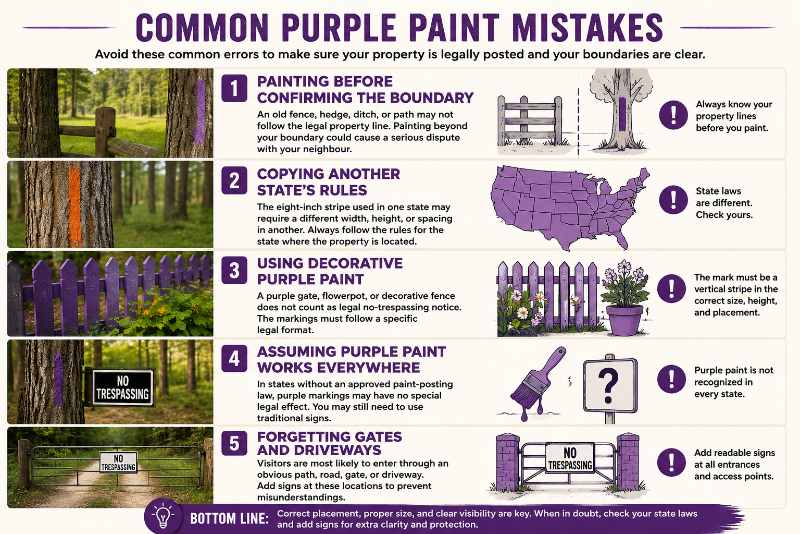
Painting Before Confirming the Boundary
An old fence, hedge, ditch, or path may not follow the legal property line.
Painting beyond your boundary could cause a serious dispute with your neighbour.
Copying Another State’s Rules
The eight-inch stripe used in one state may require a different width, height, or spacing in another.
Always follow the rules for the state where the property is located.
Using Decorative Purple Paint
A purple gate, flowerpot, garden ornament, or decorative fence panel does not necessarily count as a legal no-trespassing notice.
The markings normally need to follow a specific legal format.
Assuming Purple Paint Works Everywhere
In states without an approved paint-posting law, purple markings may have no special legal effect.
Landowners may still need to use traditional signs or another legally recognized method.
Forgetting Gates and Driveways
Visitors are most likely to enter through an obvious path, road, gate, or driveway.
Adding readable signs at these locations can help prevent misunderstandings and accidental trespassing.
Other Ways to Improve Rural Property Privacy
Purple paint is only one part of managing private property.
Clearly maintained fences, gates, boundary posts, and natural barriers can make it easier for visitors to recognize where private land begins.
For a softer and more natural boundary, consider these 13 living privacy fence ideas.
Landowners should also learn about other rules that vary across the country, including these state-by-state rainwater harvesting laws.
Frequently Asked Questions
Does purple paint always mean no trespassing?
No. Purple paint only has a specific legal meaning in states that officially recognize it.
Even within those states, the exact activities covered by the law may vary.
Can purple paint completely replace signs?
In some states, it can. In others, signs may still be required at gates, roads, driveways, or other entrances.
Check your local requirements before removing existing signs.
Can I use any shade of purple?
Use clearly recognizable purple outdoor paint that is suitable for property or forestry marking.
The paint should remain visible in different weather conditions and must meet any colour requirements established by state law.
Can I paint a neighbour’s fence?
No. Never paint another person’s tree, post, fence, or structure without their permission.
Shared fences may require agreement from every affected property owner.
Does purple paint establish the legal property line?
No.
Purple paint marks a boundary that the landowner believes to be correct, but it does not replace a property deed, recorded survey, or court decision.
What should hikers do when they see purple paint?
Do not cross the marked boundary.
Turn around, remain on the established public trail, or confirm the correct route using a reliable map.
Is the Purple Paint Law coming to every state?
There is no nationwide Purple Paint Law.
These laws are introduced and adopted individually by each state. Other states may consider similar rules in the future, but landowners should continue using their state’s currently approved posting methods until a new law officially takes effect.
Important Legal Disclaimer
This article provides general educational information and is not legal advice.
Trespassing, property-posting, and hunting laws can change. Requirements may also vary by county or municipality.
Before marking land or relying on purple paint as legal notice, check the current state statute and speak with local law enforcement, a wildlife agency, a licensed surveyor, or a qualified attorney.
Final Thoughts
The Purple Paint Law is a simple idea that can solve a frustrating rural problem.
Paint cannot easily be torn down, carried away, or blown over during a storm. When applied correctly, it gives landowners a durable and affordable way to communicate that their property is private.
For everyone else, the message is equally simple.
When you see a properly placed purple stripe on a tree or fence post, respect the boundary and remain outside it.