

Seedling Sealed In Its Own Ecosystem And watered Once In 53 Years
Make sure to like Living Green and Frugally on Facebook, Shop at Amazon to help support my site and explore our PINTEREST BOARDS for innovative ways you can become self-sufficient.
The Curious Case of the Bottle Garden 🌿
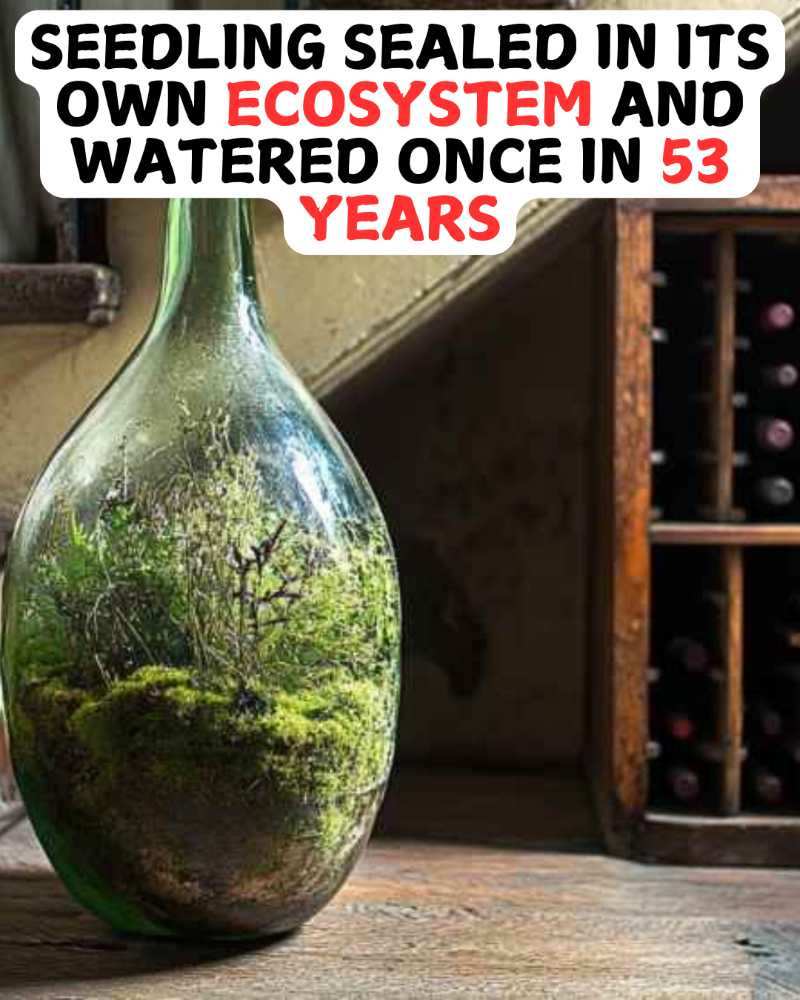
Imagine a world sealed in glass—no outside air, no watering can, no gardener’s hand for decades. Sounds like science fiction? Not quite. Meet the remarkable experiment by David Latimer: a sealed bottle garden started in 1960 that has been thriving for more than half a century. (You can read the original article on the story here.)
What happened?
Back in Easter Sunday, 1960, Latimer placed some compost, water and a cutting (from a plant in the spiderwort family) into a ten-gallon glass bottle. He sealed it and set it aside in a sunny corner. According to reports, the last time he added water was in 1972. Since then—no fresh air, no new water, no fertilizer—yet the contents still live and grow. My Modern Met
Why is this so intriguing?
- Self-sustaining ecosystem: The bottle effectively became a miniature closed ecological system. The plants photosynthesize, producing oxygen and using carbon dioxide; moisture evaporates, condenses and drips back down; fallen leaves decompose and release nutrients—all recycled within the sealed glass. My Modern Met+1
- Minimal human intervention: A setup like this challenges our usual assumptions about care and maintenance for living plants. Latimer’s bottle shows that under the right conditions, nature can do much of the work.
- A metaphor for sustainability: The story resonates with themes around closed-loop systems, self-reliance and ecological balance—topics particularly relevant when thinking about homesteading, off-grid living or low-maintenance green spaces.
How does it work?
Here’s a simplified breakdown of the processes at play:
- Water cycle: Inside the sealed bottle, moisture from the soil and plants evaporates, condenses on the glass and drips back down—creating a “mini-rain” effect. My Modern Met
- Gas exchange: During daylight the plant absorbs CO₂ and releases O₂; at night it takes in O₂ and releases CO₂. Dead plant matter and soil microbes help recycle carbon. Skeptics Stack Exchange
- Nutrient recycling: Leaves that die fall to the bottom, break down (via microbes and decomposers in the soil), and release nutrients that new growth can use. With no external additions, this internal cycle maintains the ecosystem. Wikipedia
- Light source: Although sealed, the bottle was placed in sunlight – the energy source for the photosynthesis that drives the system.
What this teaches us
- Nature can be resilient: Even in constrained conditions, given the correct setup, plants can manage to survive—and even thrive—without typical care.
- Closed systems are possible: On a small scale, a sealed bottle becomes a model for larger ideas like biospheres, greenhouses or self-sustaining living units.
- Relevance to homesteading/off-grid thinking: If a bottle can sustain life without intervention, imagine what principles you can apply on a larger scale for minimal-maintenance gardens or living spaces.
- Observation over action: Sometimes systems that look like “doing nothing” are in fact quietly doing everything—they just don’t need our constant input.
Why it matters for you
If you’re into homesteading, eco-living or simply want an indoor green feature that doesn’t demand daily watering, the bottle garden story is a powerful inspiration. It shows that with the right container, plant, location and initial setup, you can create a low-maintenance green corner that largely looks after itself. It’s a great talking point for blog posts on self-sufficiency, minimal-maintenance gardens, or even educational experiments with kids.
Some caveats & FAQs
Q1: Is the bottle truly 100% closed (no air exchange)?
A: Probably not perfectly. Some scientists and skeptics suggest that even “sealed” bottles may have minimal gas exchange around seals or corks. Skeptics Stack Exchange
Q2: Can I replicate this and expect decades of success?
A: Possibly—but many variables matter (type of plant, bottle size, soil mix, light exposure, initial water/nutrient load). The success of Latimer’s bottle may reflect a perfect storm of favourable conditions.
Q3: What species of plant was used?
A: It was reported to be a spiderwort (genus Tradescantia or similar) cutting—known for being hardy and adaptable. My Modern Met+1
Q4: Why hasn’t mould or collapse occurred?
A: Because an internal balance has been achieved—moisture, nutrients, gas exchange and microbial action all seem to be in equilibrium. If that balance were disrupted (too much light, overheating, excess humidity), the system could fail.
Q5: What’s the scholarly consensus?
A: While the story is widely cited, scientists remain cautious—there are no published peer-reviewed detailed studies about this specific bottle system. But the underlying mechanisms (closed ecosystems, terrariums) are well understood. Skeptics Stack Exchange+1
Final thoughts
In a world where we often think we must intervene—water the plant, fertilize the soil, prune the leaves—this bottle garden quietly proves otherwise. It invites us to step back, set up the conditions, then trust that nature will handle much of the rest. For anyone exploring minimalist gardens, self-sustaining systems, indoor green spaces or educational experiments, it’s a powerful story worth sharing and learning from.
👉 Click the link below to see the original article and get inspired by this remarkable sealed-bottle experiment. Original source: see “Thriving Garden in Sealed Bottle” (via Daily Mail) – re-reported here and elsewhere.