

Dehydrating Veggies Guide And Tips
Make sure to like Living Green and Frugally on Facebook, Shop at amazon to help support my site and explore our PINTEREST BOARDS for innovative ways you can become self-sufficient.
Have you ever watched a basket of fresh vegetables slowly wilt in the fridge because you could not use them quickly enough?
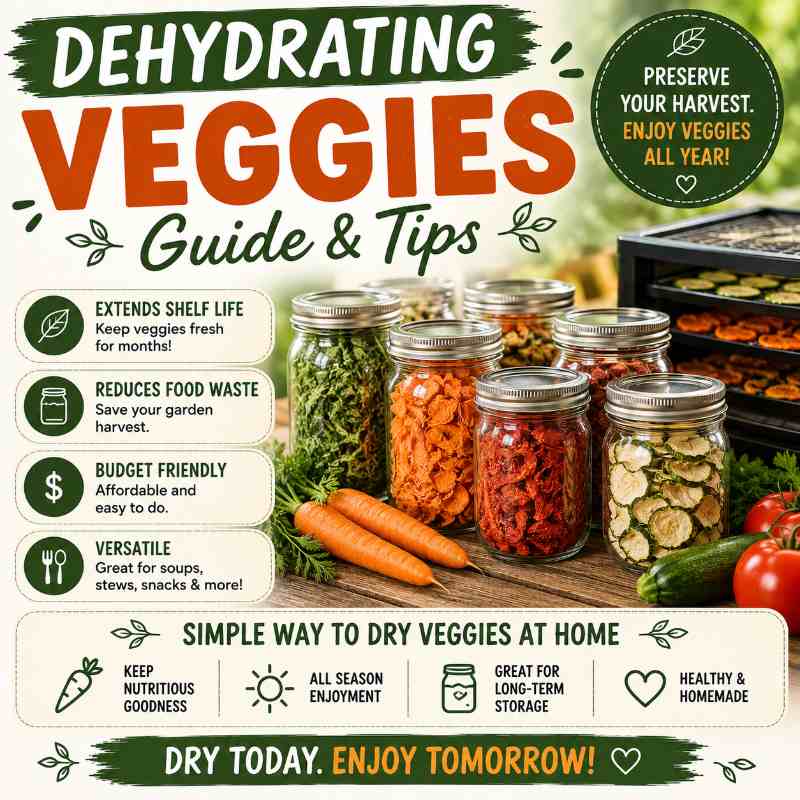
Dehydrating vegetables is one of the simplest ways to preserve a large garden harvest, reduce food waste, and fill your pantry with useful ingredients for soups, stews, casseroles, sauces, and homemade seasoning mixes.
Once the moisture has been removed, vegetables become smaller, lighter, and easier to store. You do not need freezer space, and you can take out exactly the amount you need without opening a large jar or packet.
However, successful dehydrating is not just about slicing vegetables and turning on a machine. Correct preparation, blanching, drying, cooling, and storage all matter.
This dehydrating veggies guide will take you through the process step by step. 🥕🌽
Why Dehydrate Vegetables?
Dehydrating is especially useful when you have:
- A sudden glut of garden vegetables
- Reduced produce from the supermarket
- Vegetables beginning to lose freshness
- Limited freezer or pantry space
- A desire to make lightweight camping meals
- Ingredients you regularly use in soups and casseroles
Drying removes enough moisture to prevent bacteria, yeast, and mould from growing while the food remains properly dried and stored. Dehydrated vegetables also take up considerably less room than fresh, frozen, or canned produce.
For even more ideas, take a look at:
36 Fool-Proof Dehydrator Recipes
https://www.livinggreenandfrugally.com/36-fool-proof-dehydrator-recipes/
What Equipment Do You Need?
You do not need a kitchen full of expensive equipment.
The basic items are:
- An electric food dehydrator or low-temperature oven
- A sharp knife or mandoline slicer
- Chopping boards
- A large saucepan and colander
- A bowl of iced water
- Clean kitchen towels or paper towels
- Airtight jars or food-storage containers
- Labels and a permanent marker
An electric dehydrator normally gives the most consistent results because it controls both heat and airflow.
An oven can work, but it needs to maintain a low temperature. Oven drying is usually slower and can use more electricity. For fruit and vegetables, oven temperatures are generally kept around 140°F to 150°F, or 60°C to 66°C. Increasing the heat to speed things up can dry the outside while trapping moisture inside, a problem known as case hardening.
Choosing Vegetables To Dehydrate
Always begin with fresh vegetables in good condition.
Dehydrating will not improve vegetables that are mouldy, slimy, badly bruised, or already starting to spoil.
The best vegetables for beginners include:
- Carrots
- Peppers
- Onions
- Peas
- Sweetcorn
- Green beans
- Broccoli
- Mushrooms
- Celery
- Courgettes or zucchini
- Kale and other leafy greens
Use vegetables at their best quality whenever possible. This gives you better flavour, colour, texture, and storage life.
If some of your crops store better fresh, this guide may also be helpful:
20 Crops That Keep And How To Store Them
https://www.livinggreenandfrugally.com/20-crops-keep-store/
How To Dehydrate Vegetables Step By Step
1. Wash Everything Thoroughly
Wash your hands, equipment, preparation surfaces, and vegetables.
Rinse vegetables under clean running water to remove soil, insects, and debris. Remove damaged or spoiled areas rather than trying to dry them.
2. Peel And Trim When Needed
Remove stalks, tough skins, seeds, roots, and damaged leaves.
Not every vegetable needs peeling. Thin-skinned courgettes, mushrooms, and peppers can usually be dried with their skins attached.
Carrots, parsnips, potatoes, and beetroot may be peeled if the skins are tough or marked.
3. Cut Pieces To A Similar Size
Uniform pieces dry more evenly.
If some slices are thick and others are paper-thin, the smaller pieces may become brittle long before the larger pieces are properly dried.
Aim for:
- Thin slices for carrots, onions, courgettes, and mushrooms
- Small florets for broccoli and cauliflower
- Short pieces for green beans
- Small cubes for potatoes and root vegetables
- Thin strips or rings for peppers
A mandoline can help, but always use the safety guard.
Do Vegetables Need Blanching Before Dehydrating?
Most vegetables should be blanched before drying.
Blanching means briefly heating vegetables in boiling water or steam, followed by rapid cooling. It helps reduce microorganisms, slows enzyme activity, preserves colour and flavour, and can help vegetables dry more evenly.
Drying alone does not necessarily kill bacteria. It removes the moisture bacteria need to grow. Once dried vegetables are rehydrated, bacteria may begin growing again if the food is handled or stored incorrectly.
Common vegetables that may be dried without blanching include:
- Diced onions
- Green onions
- Leeks
- Peppers
Follow tested instructions for the particular vegetable you are preparing. Blanching for too little time may fail to deactivate enzymes, while blanching for too long can produce soft vegetables and reduce quality.
Simple Water-Blanching Method
- Bring a large saucepan of water to a full boil.
- Add a manageable batch of prepared vegetables.
- Cover the pan.
- Allow the water to return to the boil.
- Start timing once the water is boiling again.
- Remove the vegetables at the recommended time.
- Immediately transfer them to cold or iced water.
- Drain thoroughly.
- Pat away excess surface moisture before drying.
Useful boiling-water blanching times include:
- Sliced or diced carrots: 2 minutes
- Green beans: 3 minutes
- Broccoli florets: 3 minutes
- Cauliflower florets: 3 minutes
- Shredded cabbage: 1½ minutes
- Green peas: 1½ to 2½ minutes
- Sliced celery: 3 minutes
- Cubed turnips or parsnips: 3 minutes
Steam blanching usually takes longer than boiling-water blanching.
Filling The Dehydrator Trays
Arrange the prepared vegetables in a single layer.
Pieces can sit close together, but they should not overlap. Air needs to circulate around as much of the surface as possible.
Try to place similar-sized pieces on the same tray. This makes it easier to remove vegetables as they become dry.
Set the dehydrator according to its instructions or a tested recipe for the vegetable. Many vegetable-drying instructions use a temperature close to 125°F, or 52°C, but the correct setting can vary by vegetable and machine. Always check the manufacturer’s guide.
Drying time can be affected by:
- Vegetable type
- Slice thickness
- Initial moisture content
- Room humidity
- Tray position
- Air circulation
- Dehydrator design
- How full the machine is
Avoid relying on the clock alone.
How To Tell When Vegetables Are Dry

Most properly dehydrated vegetables should feel hard, crisp, or brittle.
Allow a test piece to cool before checking it. Warm vegetables can feel softer than they really are.
Look for these signs:
- Carrots should be hard and brittle.
- Peas should be firm, shrivelled, and hard.
- Green beans should feel brittle.
- Onions should be crisp and break easily.
- Peppers should feel leathery to brittle.
- Mushrooms should feel dry and brittle.
- Leafy greens should crumble easily.
- Sweetcorn should be hard and shrivelled.
If the centre still feels cool, soft, flexible, or damp, continue drying.
Cooling And Packing Dehydrated Vegetables
Once the vegetables are completely dry, allow them to cool for approximately 30 to 60 minutes before packing.
Do not pack warm vegetables into sealed jars. Warm food can create condensation inside the container.
Do not leave them exposed for hours either, especially in a humid kitchen, because dried food can begin absorbing moisture from the air again.
Suitable containers include:
- Clean glass jars with tight lids
- Food-safe airtight tubs
- Vacuum-sealed bags
- Moisture-resistant freezer bags
- Metal containers with tight-fitting lids
Glass jars are particularly useful because you can easily spot condensation or changes in the food.
Frugal households may already have suitable jars available:
12 Things Frugal People Still Save In Glass Jars
https://www.livinggreenandfrugally.com/12-things-frugal-people-still-save-in-glass-jars/
How To Store Dried Vegetables
Store containers somewhere cool, dry, and dark.
Keep them away from:
- Direct sunlight
- Cookers and ovens
- Radiators
- Boilers
- Damp cellars
- Hot garages
- Areas with large temperature changes
Label every container with the vegetable and drying date.
Home-dried foods generally keep their best quality for approximately 4 to 12 months, depending on the food and storage conditions. Dried vegetables often have a shorter quality life than dried fruit, particularly when stored somewhere warm.
Check the containers regularly during the first few weeks.
If you see condensation, the vegetables were not dry enough or moisture has entered the container. Food that is still sound may be redried immediately. Any food showing mould, an unpleasant smell, or clear spoilage should be discarded.
A larger pantry-storage guide can be found here:
The Survival Pantry: 25 Foods That Last Longer Than You Think
https://www.livinggreenandfrugally.com/the-survival-pantry-25-foods-that-last-longer-than-you-think/
How To Use Dehydrated Vegetables
Dried vegetables are brilliant for meals where they can absorb cooking liquid.
Add them directly to:
- Soups
- Stews
- Casseroles
- Pasta sauces
- Rice dishes
- Homemade instant noodle mixes
- Slow-cooker meals
- Stuffing mixtures
You can also grind completely dry vegetables into powders.
Try making:
- Onion powder
- Garlic powder
- Tomato powder
- Mushroom powder
- Spinach powder
- Mixed vegetable seasoning
Vegetables can be rehydrated in hot or cold water before cooking. Leafy greens may soften after about 30 minutes in boiling water, while firmer vegetables such as carrots, peas, beans, and sweetcorn may take longer.
If soaking continues for more than two hours, refrigerate the vegetables during the remaining soaking time. Once rehydrated, treat them like fresh vegetables and keep them refrigerated until used.
For a useful way to preserve a large potato harvest, see:
How To Make Dehydrated Potato Flakes From Scratch
https://www.livinggreenandfrugally.com/dehydrated-potato-flakes-from-scratch/
Helpful Dehydrating Tips 🌿
Start With One Vegetable
Different vegetables can require different preparation and drying times. Learning with one full batch makes it easier to judge the finished texture.
Keep Notes
Write down the vegetable, preparation method, slice thickness, temperature, drying time, and final result.
Your notes will make the next batch much easier.
Rotate Trays When Necessary
Some dehydrators dry more quickly near the heating element or fan. Rotate trays if your manufacturer recommends it.
Do Not Overload The Machine
A tightly packed dehydrator restricts airflow and increases drying time.
Dry Strong-Smelling Foods Separately
Onions, garlic, mushrooms, and hot peppers can transfer aromas to milder foods.
Be Careful With Hot Peppers
Wear gloves when cutting very hot chillies. Good ventilation is also important because the fumes can irritate the eyes and throat.
Use A Purpose-Built Drying Rack
A rack can make it easier to organise produce, trays, jars, and equipment during harvest season.
How To Build A Food Storage Drying Rack/Shelf
https://www.livinggreenandfrugally.com/diy-how-to-build-a-food-storage-drying-rackshelf/
Common Dehydrating Mistakes
Cutting Pieces Too Thick
Thick pieces can remain damp inside even when the outside appears dry.
Skipping Blanching
This may reduce colour, flavour, texture, and storage quality for vegetables that require pretreatment.
Using Too Much Heat
High temperatures can cook the outside and trap moisture inside.
Packing Food While Warm
This can create condensation and encourage spoilage.
Guessing Dryness While Food Is Hot
Always cool a test piece before deciding whether the batch is finished.
Storing Jars Near Heat Or Sunlight
Warm temperatures and light reduce quality and shorten storage life.
Mixing Partly Dried And Fully Dried Pieces
Moisture from one under-dried piece can spread through an entire container.
Frequently Asked Questions
What is the best temperature for dehydrating vegetables?
Many vegetables are dried at approximately 125°F, or 52°C, in an electric dehydrator. Follow the appliance instructions and tested guidance for the individual vegetable.
How long does it take to dehydrate vegetables?
It can take several hours or longer. Drying time depends on the vegetable, thickness, humidity, preparation, temperature, airflow, and dehydrator design.
Can I dehydrate vegetables without blanching them?
Some vegetables, including peppers, diced onions, green onions, and leeks, are commonly dried without blanching. Most other vegetables benefit from correct blanching before drying.
Can vegetables be dehydrated in an oven?
Yes, provided the oven can maintain a low, stable temperature and allow sufficient airflow. Oven drying normally takes longer than using a dehydrator.
Can I dehydrate frozen vegetables?
Yes. Many frozen vegetables have already been commercially blanched, which can reduce preparation time. Check the packaging, thaw if necessary, drain thoroughly, and spread the vegetables evenly.
Why did my dried vegetables go mouldy?
They may not have been completely dry, they may have been packed while warm, or moisture may have entered the container during storage.
Do dehydrated vegetables need refrigeration?
Properly dried vegetables do not usually require refrigeration while sealed and stored correctly. Refrigeration or freezing can extend quality, especially in hot or humid conditions.
Is sun drying vegetables safe?
Sun and solar drying are difficult in areas with inconsistent heat or high humidity. Food may mould before it dries completely, and outdoor food can be exposed to insects and contamination. A temperature-controlled dehydrator is generally easier for beginners.
Food Safety Note
Home food preservation must be carried out carefully. Always use clean equipment, fresh produce, tested preparation methods, and the correct blanching instructions for each vegetable.
Never taste dried food that smells unpleasant, contains mould, feels unexpectedly moist, or shows signs of insect contamination.
When in doubt, throw it out.
Final Thoughts
Dehydrating vegetables is a wonderfully practical skill for gardeners, bargain hunters, campers, and anyone trying to waste less food.
The most important things to remember are simple: begin with good produce, slice it evenly, blanch when required, dry it completely, cool it before packing, and protect it from moisture during storage.
Once you have successfully dried your first batch of carrots, onions, peppers, or leafy greens, you may find yourself looking at every surplus vegetable as another useful jar for the pantry.