

How to Make Homemade Butter: Easy Step-by-Step Recipe
Make sure to like Living Green and Frugally on Facebook,Shop at Amazon to help support my site and explore our PINTEREST BOARDS for innovative ways you can become self-sufficient.
The Simple Old-Fashioned Kitchen Skill That Feels Like Magic
There is something strangely satisfying about making your own butter at home. You start with a simple carton of cream, give it a little time and movement, and suddenly you have fresh, creamy, golden homemade butter sitting in your kitchen like something from an old farmhouse.
The best part? You do not need fancy equipment, special ingredients, or years of experience.
Homemade butter is one of those forgotten kitchen skills that sounds impressive, but is actually surprisingly easy. Once you make it for the first time, you may wonder why more people do not do it. It tastes fresher, feels more natural, and gives you that lovely “I made this myself” feeling that shop-bought butter just cannot compete with.
Whether you want to save money, use up cream, teach kids a fun kitchen lesson, or simply enjoy a more traditional way of cooking, this guide will show you how to make homemade butter step by step.
Why Make Homemade Butter? 🧈
Making butter at home is not just about the butter. It is about slowing down, learning a useful skill, and getting more from simple ingredients.
Here is why homemade butter is worth trying:
1. It tastes fresher
Fresh butter has a rich, creamy flavour that feels cleaner and more natural than many store-bought versions.
2. You control the ingredients
Want salted butter? Add salt. Want unsalted butter? Leave it plain. Want garlic herb butter? Mix it in. You are in charge.
3. It is a fun kitchen project
Kids especially love watching cream turn into butter. It feels like a little science experiment you can eat.
4. You also get buttermilk
When the butter separates, you are left with buttermilk, which can be used in pancakes, biscuits, scones, cakes, and marinades.
5. It connects you to old-fashioned cooking
Before supermarkets made everything easy, people made simple foods like butter at home. Bringing back that skill feels practical and rewarding.
What You Need To Make Homemade Butter

You only need one main ingredient.
Ingredients
- 2 cups heavy cream, double cream, or whipping cream
- Pinch of salt, optional
Equipment
- Stand mixer, hand mixer, food processor, or clean jar with a lid
- Bowl
- Fine sieve or cheesecloth
- Wooden spoon or spatula
- Cold water
That is it. No complicated tools. No strange ingredients. Just cream and a little patience.
How To Make Homemade Butter Step By Step 🧈
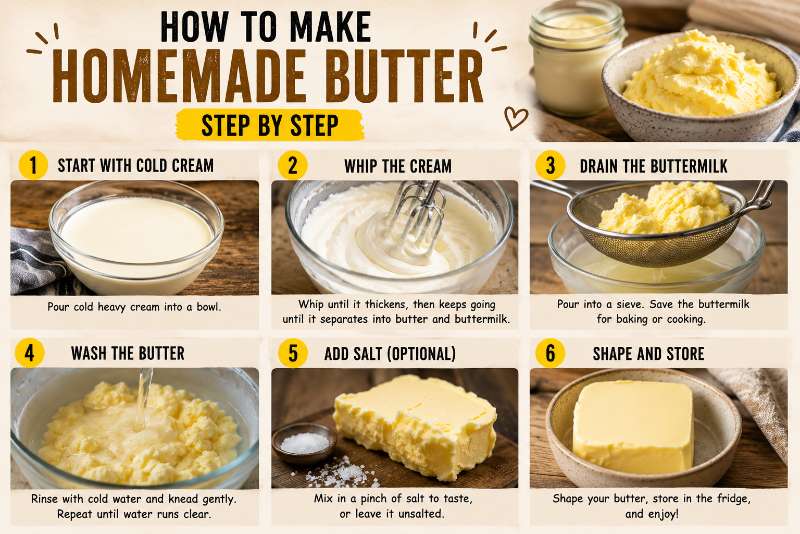
Step 1: Start With Cold Cream
Pour your cream into a mixing bowl, food processor, or clean jar.
Cold cream works well because it helps the butter form nicely. If you are using a stand mixer or hand mixer, make sure your bowl is deep enough because cream can splash as it thickens.
Step 2: Whip The Cream
Start whipping the cream. At first, it will look like normal cream. Then it will become whipped cream. Keep going.
This is the part where many people stop too early. You need to keep mixing past the whipped cream stage.
After a few more minutes, the cream will start to look grainy. Then suddenly, it will split. You will see yellow clumps of butter forming and a thin liquid separating from it. That liquid is buttermilk.
This is the magic moment.
Step 3: Drain The Buttermilk
Place a sieve over a bowl and pour the mixture into it.
The liquid that drains off is buttermilk. Do not throw it away. Save it in a jar and keep it in the fridge. It is lovely in baking and cooking.
The solid yellow clumps left behind are your homemade butter.
Step 4: Wash The Butter
This step is important if you want your butter to last longer.
Place the butter into a bowl and pour over very cold water. Press and fold the butter with a spatula or clean hands. The water will turn cloudy as more buttermilk comes out.
Pour away the cloudy water and repeat with fresh cold water until the water runs mostly clear.
This removes leftover buttermilk, which can make butter spoil faster.
Step 5: Add Salt If You Want
Now you can leave the butter plain or mix in a pinch of salt.
Start small. You can always add more, but you cannot take it out once it is mixed in.
For a simple salted butter, try about 1/4 teaspoon salt per cup of finished butter, then adjust to taste.
Step 6: Shape And Store
Press the butter into a small dish, roll it in parchment paper, or shape it into a little block.
Keep homemade butter in the fridge and use it within about a week. You can also freeze it for longer storage.
Jar Method: The Fun Way To Make Butter With Kids 👩🍳
No mixer? No problem.
Pour cream into a clean jar, filling it only halfway. Put the lid on tightly and shake.
At first it will slosh. Then it will become thick. Then it may feel like nothing is moving. Keep shaking. Eventually, the butter will separate from the buttermilk.
This method takes more effort, but it is fun, simple, and perfect for showing children how butter is made.
Tip: Let everyone take turns shaking the jar.
Easy Flavour Ideas For Homemade Butter 🌿
Once you know how to make basic butter, you can turn it into something special.
Try these ideas:
Garlic herb butter
Mix in crushed garlic, parsley, and a little salt.
Honey butter
Add a spoonful of honey for spreading on warm rolls or cornbread.
Cinnamon sugar butter
Mix in cinnamon and a little sugar for toast, pancakes, or waffles.
Lemon pepper butter
Add lemon zest and black pepper for fish, vegetables, or chicken.
Chilli butter
Mix in chilli flakes for a spicy kick.
Homemade flavoured butter also makes a lovely gift. Put it in a small jar, add a label, and it looks like something from a farmhouse market.
Tips For The Best Homemade Butter
Use good cream
The better the cream, the better the butter. Heavy cream, double cream, or whipping cream all work.
Do not stop at whipped cream
Keep mixing until the butter separates from the buttermilk.
Wash the butter well
This helps remove leftover buttermilk and keeps the butter fresher.
Use very cold water
Cold water helps the butter firm up and makes it easier to work with.
Season slowly
Add salt a little at a time and taste as you go.
Save the buttermilk
Use it in pancakes, biscuits, cakes, mashed potatoes, or chicken marinades.
Common Mistakes To Avoid
Stopping too soon
The cream must go past the whipped cream stage. If it still looks fluffy and smooth, it is not butter yet.
Not draining properly
Too much liquid left in the butter can make it watery and spoil faster.
Skipping the washing step
Washing butter may sound old-fashioned, but it really does help improve texture and storage.
Adding too much salt
A little salt goes a long way. Start with a pinch and build from there.
Using low-fat cream
Butter needs fat. Low-fat cream will not work the same way.
What Can You Use Homemade Butter For?
Use homemade butter anywhere you would use regular butter.
It is delicious on:
- Fresh bread
- Toast
- Jacket potatoes
- Pancakes
- Cornbread
- Scones
- Vegetables
- Scrambled eggs
- Homemade biscuits
- Roast chicken
- Baked potatoes
It also melts beautifully into sauces and tastes amazing on warm bread straight from the oven.
Common Questions About Making Homemade Butter
Can I make butter with single cream?
It is best to use heavy cream, double cream, or whipping cream because butter needs a high fat content. Single cream may not separate properly.
How long does homemade butter last?
Homemade butter usually lasts about one week in the fridge if washed well and stored in a clean container. You can freeze it for longer storage.
Can I make butter without a mixer?
Yes. You can make butter in a jar by shaking cream until it separates. It takes more effort, but it works.
Why is my butter too soft?
It may be too warm or still have too much buttermilk inside. Wash it with cold water and chill it in the fridge.
Is homemade butter cheaper than store-bought?
It depends on the price of cream where you live. Sometimes it is not cheaper, but it is fresher, customizable, and gives you buttermilk as a bonus.
Can I use the leftover buttermilk?
Yes. Save it for pancakes, biscuits, cakes, scones, marinades, or creamy mashed potatoes.
Can I freeze homemade butter?
Yes. Wrap it well and freeze it. For best results, divide it into smaller portions before freezing.
Final Thoughts 🧈
Learning how to make homemade butter is one of those simple kitchen skills that feels surprisingly rewarding. It takes one ingredient, a few minutes of effort, and gives you something fresh, useful, and delicious.
It is perfect for beginners, fun for families, and a brilliant way to bring a little old-fashioned self-sufficiency back into your home.
Once you spread your own butter on warm bread, you may never look at a carton of cream the same way again.
Try it once and you will see why this simple kitchen trick has been loved for generations.